Studio DARKUV / Art / Data Art
"What if the numbers that describe your life could become something you wear?"
With a background in media and programming, I have always been interested in what data actually looks like, but not as a spreadsheet, but as something everyone could understand, some very clear explanation about something going on in life, amd maybe even a physical object you can hold. Data is already used constantly in jewellery: birthstones, engraved dates, initials. But I wanted to go further and ask what happens when you take a larger, stranger, more intimate sample of personal data and let it drive the design.
The pieces in this collection each begin with a dataset. Downloaded, analysed, and then translated into form through code I write myself. The result is jewellery that could not have been designed any other way. It belongs to a specific person, a specific moment, a specific set of numbers and a story that no one else will ever have.
The next two pieces in this series were shown at the National Museum of Kazakhstan and Munich Jewelry Week as part of the international group exhibition The Jewelry Code: Data as Wearable Art - an exhibition exploring the intersection of personal data, technology, and contemporary jewellery practice. The works were received as part of a broader conversation about identity, privacy, politics and what it means to make something truly personal in an age of mass data.
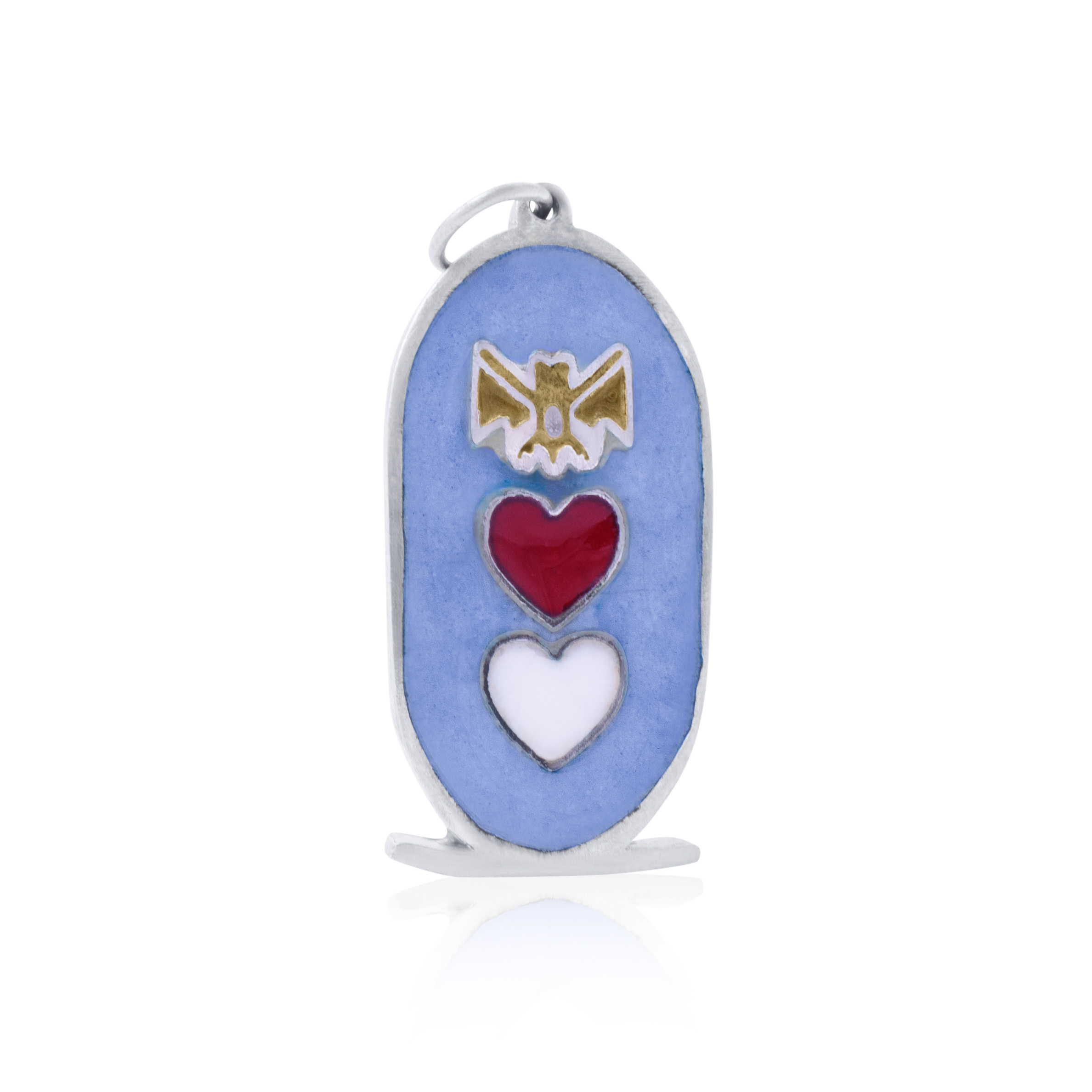
For this piece I wrote a script that analysed the full history of my WhatsApp conversation with my childhood best friend who now lives far away. The script identified the three emojis we had sent each other most often across years of messages: our private visual vocabulary, our picture-illustration of our friendship, as an object you ca hold and cherish.
Those three emojis are arranged inside a cartouche in sterling silver, coloured with hot enamel. The cartouche is a deliberate reference to ancient Egyptian hieroglyphs - a frame used to enclose the name of a pharaoh, a form that has carried identity for thousands of years. Here it carries something far more contemporary: the compressed emoji language of a long-distance friendship conducted mostly through a phone screen.
The title is borrowed from Python syntax with open("friendship.txt"), the command you write when you want a programme to read a file. It is also a description of what friendship usually requires.
By showing this piece publicly, I invite viewers into a private conversation. The inside jokes stay inside. But the shape of the friendship, its frequency, its warmth, its favourite symbols, become visible.
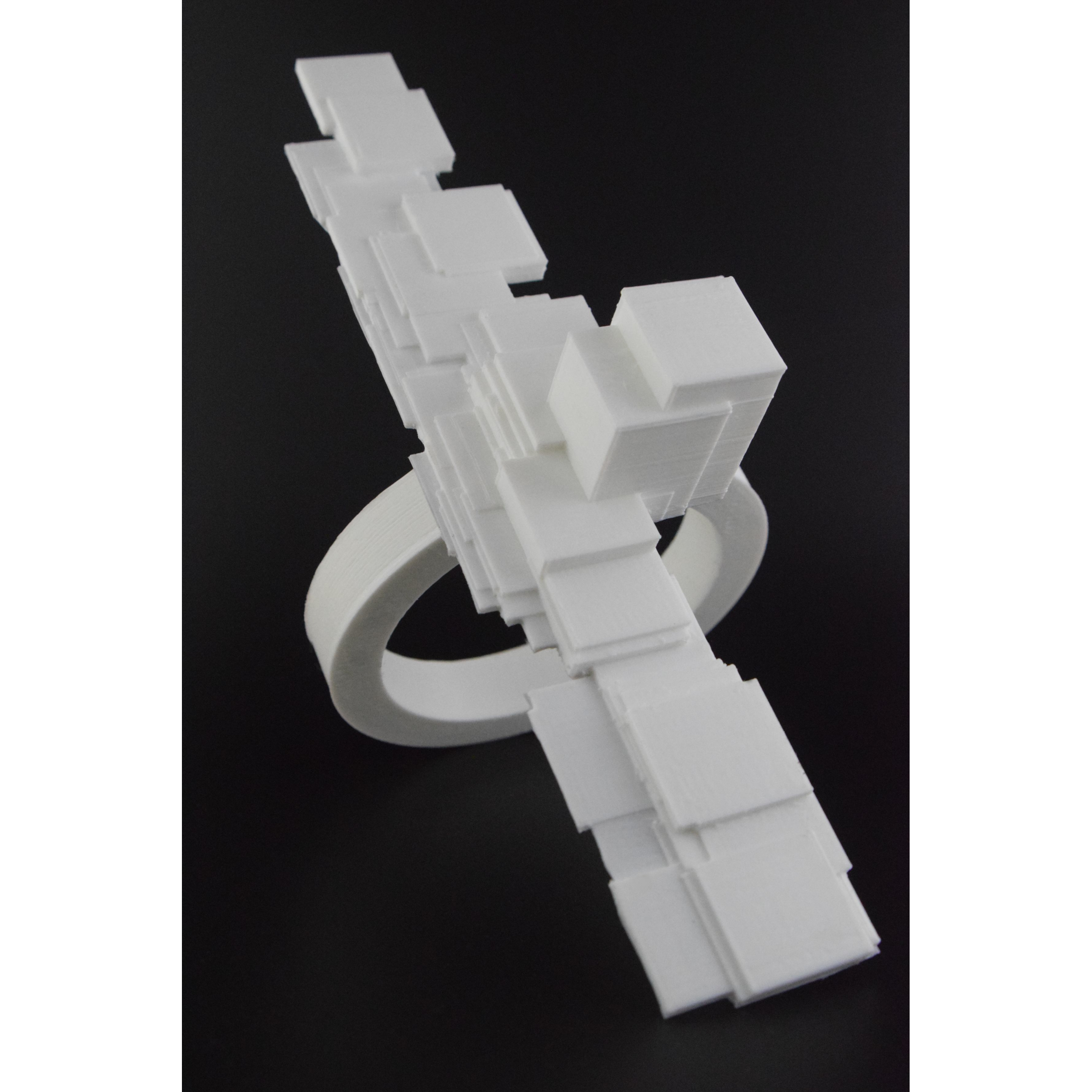
For this piece I downloaded my complete Instagram Reels data. Inside it I found something I already knew but had never seen so starkly: once, one of my reels went viral. It had been watched more than anything else I ever posted. In the raw data, that single reel was a spike so enormous it made everything else, everything I had created before and after, almost invisible by comparison.
I took the edata for that one reel and wrapped it, literally, around a wrist. The bracelet's form is driven entirely by the numbers: where the data peaks, the silver rises. Where it drops off, the silver narrows. The viral reel wraps the arm like a grip.
The title has two meanings. The first is the obvious one: the shape of the data, wrapped. The second is darker. We are all, in some way, wrapped inside the logic of algorithms that decide what to amplify and what to ignore. This piece asks you to wear that logic rather than pretend it isn't there and to consider what else you make that deserves to be seen, regardless of what any algorithm decided.
Every marketing course will tell you the same thing: stop talking about what you make and start talking about who your customer is. Describe their pain. Make them feel understood. Use the right hashtags — the ones that reach people who need you, not people who admire your process from a distance.
I know this. I have read the threads and watched the reels and taken the notes. And then I come home after a day of soldering and filing and firing enamel, and I am too tired to perform the version of myself that content strategy requires. So I write what I know: the materials, the technique, the name of the thing I just made. Sterling silver. 3D printed. Organic cast.
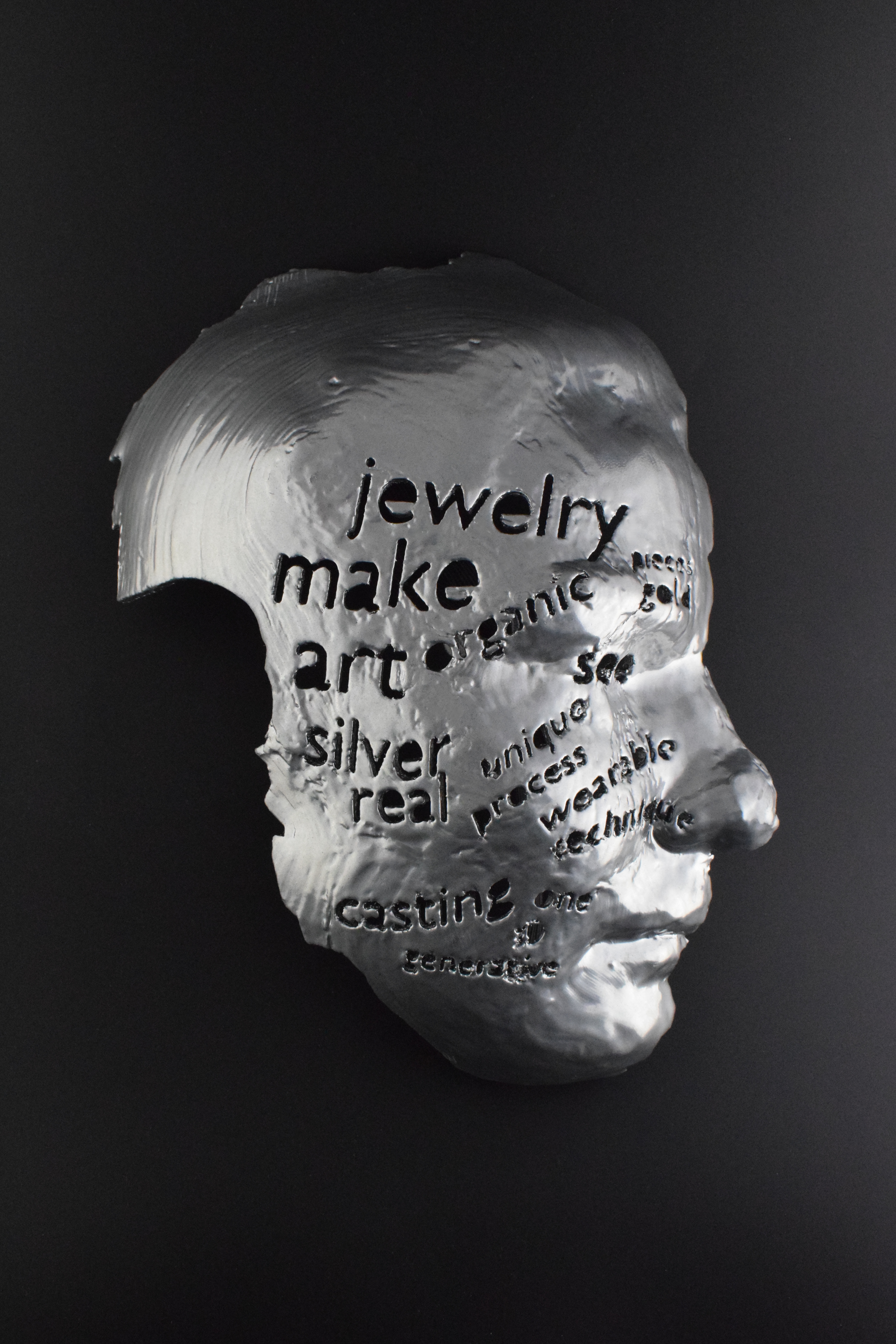
For this piece I downloaded my Instagram data as a JSON file and wrote a script to extract and rank the hashtags from my most-viewed reels. The results were exactly what I already knew they would be: a list of materials and techniques, not a list of feelings or aspirations or pain points. The data confirmed something I had suspected but never quite wanted to look at directly.
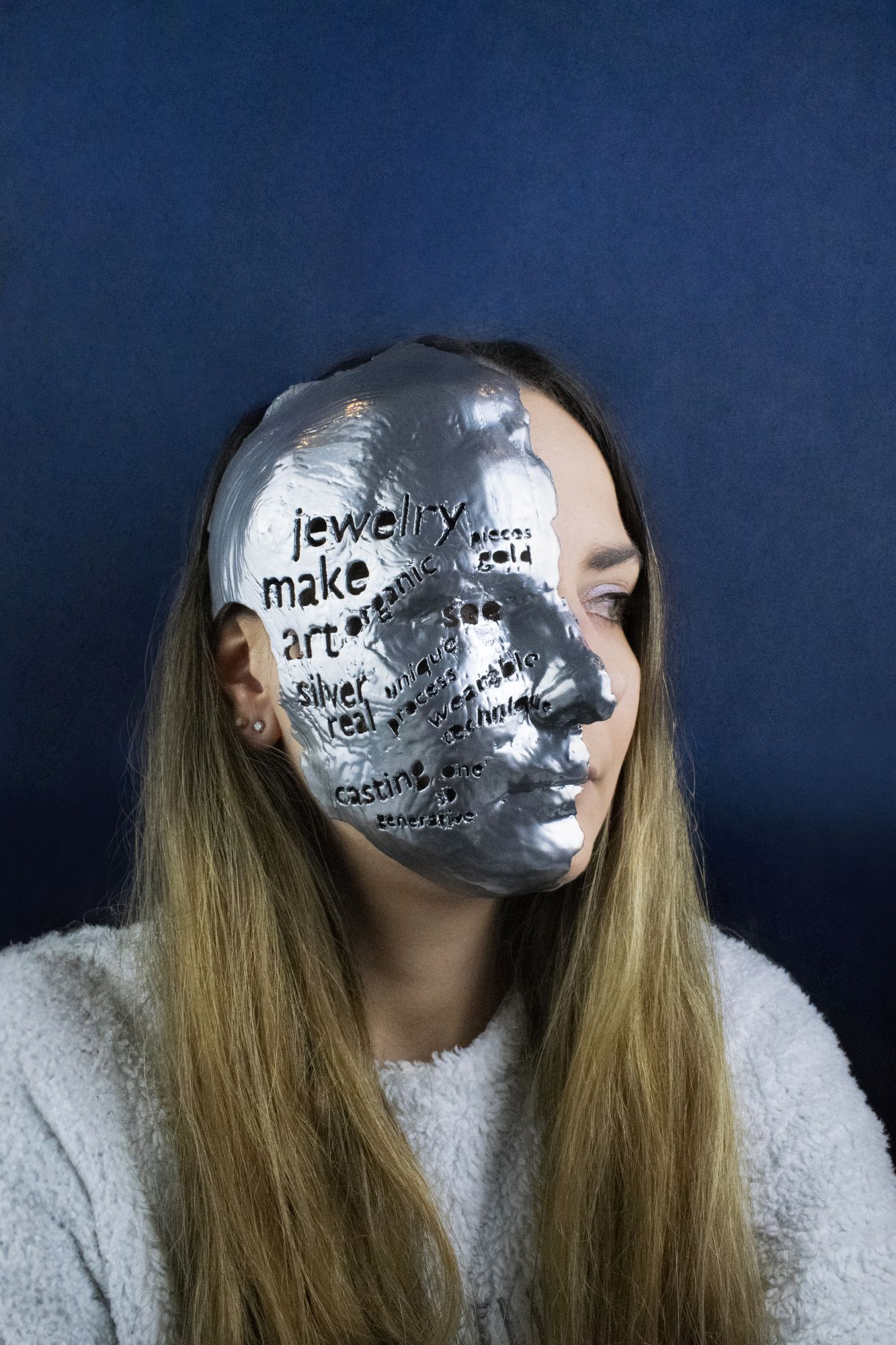
I 3D-scanned my own face, loaded the hashtag list into the model, and printed the words across the surface of the mask. Then I painted it. The mask is two things at once: an accurate self-portrait made from my own geometry, and a document of my own failure to communicate in the language the algorithm wants.
It is also, separately, a migraine mask. The weight of it across the face. The words pressing in. The feeling of having done everything technically correctly and still not being understood. Anyone who has had a migraine or who has tried to market something they love will recognise that feeling.
This piece was shown during Munich Jewelry Week as a part of the "Selling face" exhiition organized by Collective Dvizh. Artists were invited to reflect on their need in visibility online and how it affects them.